Haplo Group

Our research focusses on estimating population and social structure from DNA data. We are interested in
- Developing computational methods for analyzing ancient DNA (aDNA). We work on pushing haplotype-based methods towards the low sequencing coverage regime typical for aDNA.
- Population Genetic analysis of aDNA produced at MPI-EVA and elsewhere. One special focus is on data from the ancient Mediterranean generated via MHAAM (Max Planck – Harvard Research Center for the Archaeoscience of the Ancient Mediterranean).
Identity by Descent segments in ancient DNA
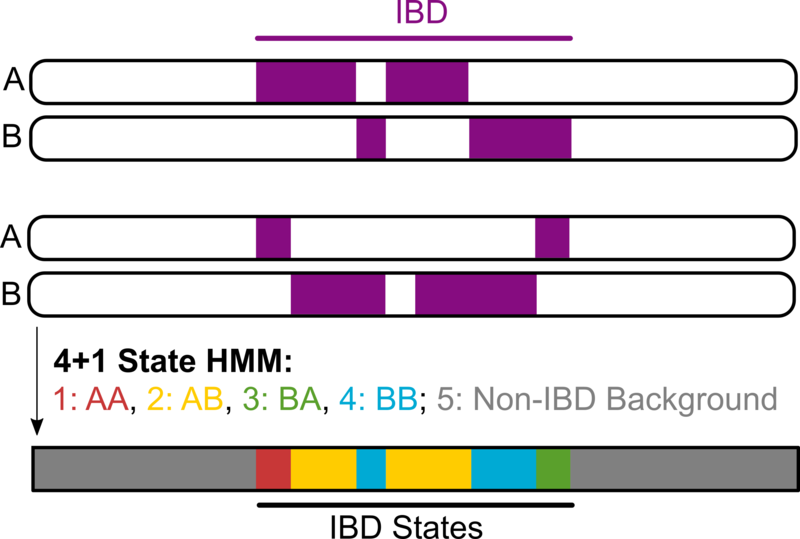
We are interested in utilizing the power of IBD segments for demographic inference. These blocks are the genomic signposts of recent genealogical connections between two individuals, they are co-inherited identically from a recent common ancestor. We have a vision based on population genetic arguments that IBD segments hold ample power to infer recent demography, such as rates of mobility and population size trajectories.
However, while such analyses are commonly applied to modern DNA, the low-coverage regime typical of aDNA data is not accessible with standard approaches. Currently, we are working on
- Detecting IBD in aDNA with specifically developed methods.
- Turning IBD segments inferred in aDNA into demographic estimates.
This progress will allow us to address key questions about the human past in a completely new way.
Group Members
Group leader
PhD researchers
- Annika Freudiger; Co-supervised with Prof. Anja Widdig, Leipzig University
- Florence Pautet
Associated PhD Researchers
- Xiaowen Jia; LMU Munich, co-supervised with Prof. Philipp Stockhammer
- Reed Morgan; Harvard University, main supervisor Prof. Michael McCormick
Visiting Researchers
- Edward Huang; Visiting researcher (Fulbright Program)
- Jiaming Xue; Visiting PhD Researcher
Group Alumni
- Yilei Huang: PhD Researcher (2021-2025); now Senior AI Engineer at Illumina
- Eirini Skourtanioti: Postdoctoral Researcher (2020-2024); now Postdoctoral Researcher in the Skoglund lab at the Francis Crick Institute, London