News
News/Press releases

Early Homo sapiens innovation and adaptation
Bacho Kiro Cave provides key insights into the technological and behavioral evolution of pioneer Homo sapiens in Europe

More plants on the menu of ancient hunter-gatherers
Isotopic evidence reveals surprising dietary practices of pre-agricultural human groups in Morocco

Homo sapiens already reached northwest Europe more than 45,000 years ago
The arrival of Homo sapiens in cold northern latitudes took place several thousand years before Neanderthals disappeared in southwest Europe

Balzan Prizes 2023 for Max Planck researchers
Jean-Jacques Hublin and Heino Falcke are among the four winners of the prestigious prize

Great white sharks may have contributed to megalodon extinction
Using zinc isotopes, researchers investigated the diet of megalodon, the largest shark to have ever lived


Early modern human from Southeast Asia adapted to a rainforest environment
New insights into the diet of our species' earliest member in the tropical rainforest of Southeast Asia

Early Homo sapiens groups in Europe faced subarctic climates
New insights into the climatic backdrop for an early wave of dispersal of our species into Europe during the last glacial period

Climatically driven landscape evolution during warm periods
New puzzle piece for understanding future natural systems


Neandertals’ main food source was definitely meat
Isotope analyses performed on single amino acids in Neandertals’ collagen samples shed new light on their debated diet

Neandertal genes influence brain development of modern humans
DNA fragments from Neandertals in the human genome shed light on brain evolution
A characteristic feature of modern humans is the unusually round…

Bone knife from Morocco: oldest specialized bone tool associated with Aterian culture
New find indicates the appearance of a unique technological complex in North Africa around 90,000 years ago
A single bone artefact found in a…

Germany was covered by glaciers 450,000 years ago
New chronological data for the Middle Pleistocene glacial cycles push back the first glaciation and early human appearance in central Germany by about…

Neanderthals thought like we do
As early as 64,000 years ago Iberian Neanderthals created cave paintings
At least 70,000 years ago Homo sapiens used perforated marine shells and…

January 24, 2018: Modern human brain organization emerged only recently
Homo sapiens fossils demonstrate a gradual evolution of the human brain towards its modern globular shape
In a paper researchers from the Max Planck…

Fossil ape skull confirms African origin of apes and humans
13-million-year-old “Alesi“, a fossil discovered in Kenya, sheds light on ape ancestry
The discovery in Kenya of a remarkably complete fossil ape…

Award ceremony in Morocco
Royal award for Max Planck Director
Jean-Jacques Hublin, Director of the Human Evolution Department at the Max Planck Institute for Evolutionary…

The first of our kind
Scientists discover the oldest Homo sapiens fossils at Jebel Irhoud, Morocco
New finds of fossils and stone tools from the archaeological site of…
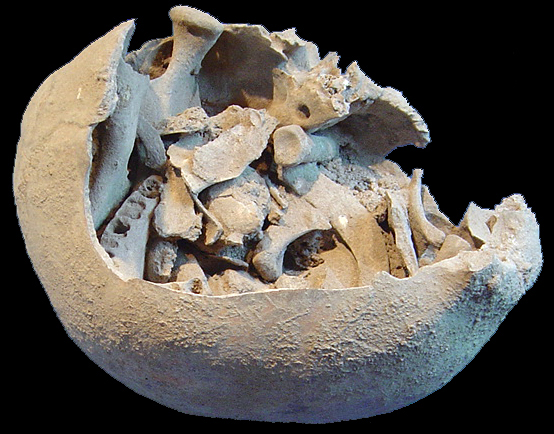
9,500-year-old funerary rituals involving the reduction of fresh corpses discovered in east central Brazil
Findings from Lapa do Santo show oldest evidence in the continent of humans performing elaborated funerary rituals based on the manipulation and…